在解析PoolChunk、PoolSubpage和PoolArena中会发现最终分配的内存和PooledByteBuf有密切的关系。
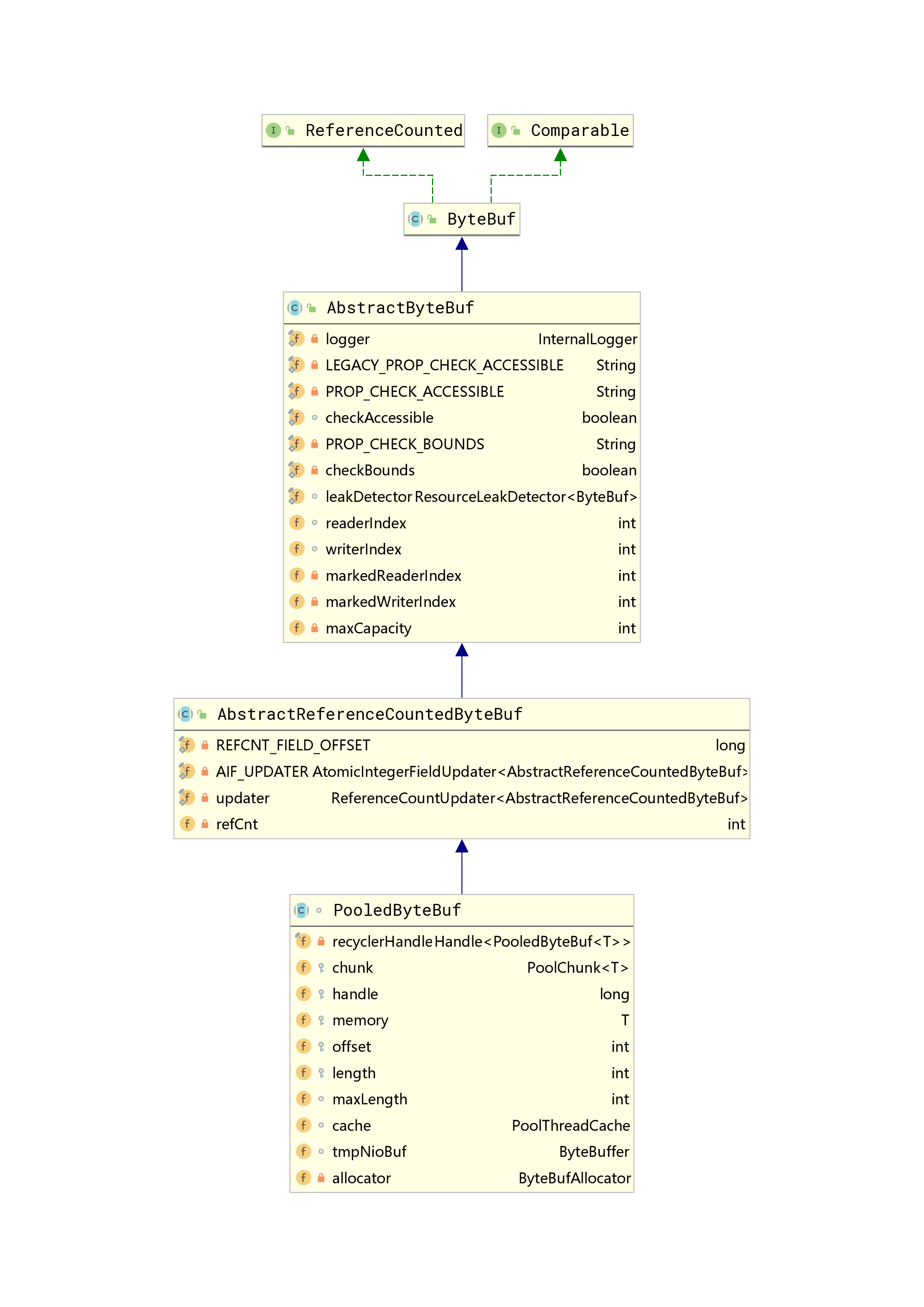
PooledByteBuf有几个实现类:PooledDirectByteBuf、PooledUnsafeDirectByteBuf、PooledHeapByteBuf、PooledUnsafeHeapByteBuf。
这些实现类从名字上就能看出它们的区别,Pooled代表池化的,Direct代表jvm外内存,Heap代表堆内存,Unsafe代表底层操作使用的是Unsafe类实现的(地址/指针操作)。
AbstractByteBuf
ByteBuf接口中的方法非常多就不解析了,主要是AbstractByteBuf抽象类。
AbstractByteBuf类通过读索引和写索引实现了可以同时读写的功能。
1
2
3
4
5
6
7
8
9
10
|
int readerIndex;
int writerIndex;
private int markedReaderIndex;
private int markedWriterIndex;
private int maxCapacity;
|
AbstractReferenceCountedByteBuf
AbstractReferenceCountedByteBuf实现引用计数的功能。
PooledByteBuf
成员变量及集成关系
1
2
3
4
5
6
7
8
9
10
11
12
13
14
15
16
17
18
19
20
21
22
| abstract class PooledByteBuf<T> extends AbstractReferenceCountedByteBuf {
private final Recycler.Handle<PooledByteBuf<T>> recyclerHandle;
protected PoolChunk<T> chunk;
protected long handle;
protected T memory;
protected int offset;
protected int length;
int maxLength;
PoolThreadCache cache;
ByteBuffer tmpNioBuf;
private ByteBufAllocator allocator;
}
|
构造器
1
2
3
4
5
| protected PooledByteBuf(Recycler.Handle<? extends PooledByteBuf<T>> recyclerHandle, int maxCapacity) {
super(maxCapacity);
this.recyclerHandle = (Handle<PooledByteBuf<T>>) recyclerHandle;
}
|
初始化init
1
2
3
4
5
6
7
8
9
10
11
12
13
14
15
16
17
18
19
20
21
22
23
24
25
26
| void init(PoolChunk<T> chunk, ByteBuffer nioBuffer,
long handle, int offset, int length, int maxLength, PoolThreadCache cache) {
init0(chunk, nioBuffer, handle, offset, length, maxLength, cache);
}
void initUnpooled(PoolChunk<T> chunk, int length) {
init0(chunk, null, 0, chunk.offset, length, length, null);
}
private void init0(PoolChunk<T> chunk, ByteBuffer nioBuffer,
long handle, int offset, int length, int maxLength, PoolThreadCache cache) {
assert handle >= 0;
assert chunk != null;
this.chunk = chunk;
memory = chunk.memory;
tmpNioBuf = nioBuffer;
allocator = chunk.arena.parent;
this.cache = cache;
this.handle = handle;
this.offset = offset;
this.length = length;
this.maxLength = maxLength;
}
|
init方法是ByteBuf复用的核心方法,在Chunk分配内存后会调用该方法
buf.init(this, nioBuffer, handle, runOffset(memoryMapIdx) + offset,
reqCapacity, runLength(memoryMapIdx), arena.parent.threadCache());
buf.init(this, nioBuffer, handle,
runOffset(memoryMapIdx) + (bitmapIdx & 0x3FFFFFFF) * subpage.elemSize + offset,
reqCapacity, subpage.elemSize, arena.parent.threadCache());
释放内存deallocate
1
2
3
4
5
6
7
8
9
10
11
12
13
14
| @Override
protected final void deallocate() {
if (handle >= 0) {
final long handle = this.handle;
this.handle = -1;
memory = null;
chunk.arena.free(chunk, tmpNioBuf, handle, maxLength, cache);
tmpNioBuf = null;
chunk = null;
recycle();
}
}
|
回收到对象池recycle()
将当前对象存储到线程ThreadLocal的栈中
1
2
3
| private void recycle() {
recyclerHandle.recycle(this);
}
|
1
2
3
4
5
6
7
8
9
10
11
12
13
| @Override
public void recycle(Object object) {
if (object != value) {
throw new IllegalArgumentException("object does not belong to handle");
}
Stack<?> stack = this.stack;
if (lastRecycledId != recycleId || stack == null) {
throw new IllegalStateException("recycled already");
}
stack.push(this);
}
|
PooledDirectByteBuf
继承关系及成员变量
1
2
3
4
5
6
7
8
9
| final class PooledDirectByteBuf extends PooledByteBuf<ByteBuffer> {
private static final Recycler<PooledDirectByteBuf> RECYCLER = new Recycler<PooledDirectByteBuf>() {
@Override
protected PooledDirectByteBuf newObject(Handle<PooledDirectByteBuf> handle) {
return new PooledDirectByteBuf(handle, 0);
}
};
}
|
构造对象newInstance
newInstance通过对象池Recycler来获取对象,当对象池中没有满足的对象时会调用newObject方法构建新的对象。
1
2
3
4
5
6
7
8
9
| static PooledDirectByteBuf newInstance(int maxCapacity) {
PooledDirectByteBuf buf = RECYCLER.get();
buf.reuse(maxCapacity);
return buf;
}
private PooledDirectByteBuf(Recycler.Handle<PooledDirectByteBuf> recyclerHandle, int maxCapacity) {
super(recyclerHandle, maxCapacity);
}
|
获取数据getBytes
1
2
3
4
5
6
7
8
9
10
11
12
13
14
15
16
17
18
| @Override
public ByteBuf getBytes(int index, ByteBuf dst, int dstIndex, int length) {
checkDstIndex(index, length, dstIndex, dst.capacity());
if (dst.hasArray()) {
getBytes(index, dst.array(), dst.arrayOffset() + dstIndex, length);
} else if (dst.nioBufferCount() > 0) {
for (ByteBuffer bb: dst.nioBuffers(dstIndex, length)) {
int bbLen = bb.remaining();
getBytes(index, bb);
index += bbLen;
}
} else {
dst.setBytes(dstIndex, this, index, length);
}
return this;
}
|
PooledHeapByteBuf
继承关系以及成员变量
1
2
3
4
5
6
7
8
9
| class PooledHeapByteBuf extends PooledByteBuf<byte[]> {
private static final Recycler<PooledHeapByteBuf> RECYCLER = new Recycler<PooledHeapByteBuf>() {
@Override
protected PooledHeapByteBuf newObject(Handle<PooledHeapByteBuf> handle) {
return new PooledHeapByteBuf(handle, 0);
}
};
}
|
构造对象newInstance
newInstance通过对象池Recycler来获取对象,当对象池中没有满足的对象时会调用newObject方法构建新的对象。
1
2
3
4
5
6
7
8
9
| static PooledHeapByteBuf newInstance(int maxCapacity) {
PooledHeapByteBuf buf = RECYCLER.get();
buf.reuse(maxCapacity);
return buf;
}
PooledHeapByteBuf(Recycler.Handle<? extends PooledHeapByteBuf> recyclerHandle, int maxCapacity) {
super(recyclerHandle, maxCapacity);
}
|
getBytes
1
2
3
4
5
6
| @Override
public final ByteBuf getBytes(int index, byte[] dst, int dstIndex, int length) {
checkDstIndex(index, length, dstIndex, dst.length);
System.arraycopy(memory, idx(index), dst, dstIndex, length);
return this;
}
|